
The Silent Competition We Never Signed Up For
There is a silent competition that most of us are part of, without ever signing up for it. You open your phone, scroll a little, and suddenly it feels like everyone is doing better than you. Someone is travelling, someone is earning more, someone is in love, someone looks happier, calmer, more “sorted.” And in that moment, your own life, which was completely fine a few minutes ago, starts to feel smaller.
The strange part is that this is not happening to just you. It is happening to everyone. Each person is looking at someone else and feeling like they are falling behind. There is always something the other person has that feels just out of reach, just enough to make us question ourselves. And slowly, without realizing it, life turns into an unfair comparison. A race that cannot be won, because it did not begin on equal ground in the first place.
How Validation Quietly Takes Over
From here begins a subtle shift in how we show up in the world. We start talking about ourselves a little more than necessary. We highlight certain parts of our lives, polish certain stories, and unconsciously wait for reactions. We look for approval in faces, in replies, in how long someone listens to us. Somewhere in between, we forget the natural pause in conversations. We forget how to just be.
What we are actually seeking is validation, but it rarely satisfies us. Even when we receive it, it does not stay. It fades quickly, and we are back to searching again. And when we do not receive it, it adds another layer to the feeling of not being enough. This is how the loop continues. Trying to prove ourselves, not because we truly want to express something, but because we want to feel worthy through someone else’s eyes.
When Yoga Makes You See Clearly
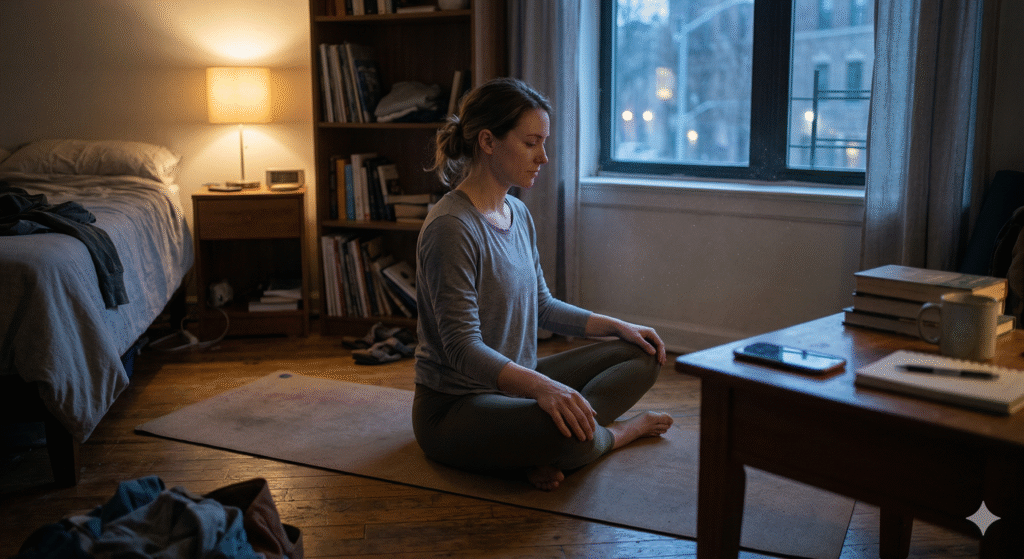
When you begin to step into yoga, this entire pattern starts becoming visible. It becomes difficult to ignore. You start noticing how conversations feel performative, how certain interactions are driven by a need to be seen in a certain way. And once you see it clearly, it becomes tiring. Because deep down, you know this is not natural. It is not you.
Yoga, in its essence, is a movement towards what is real. It is not about becoming someone else. It is about returning to yourself. And the moment this understanding begins to settle, the question naturally arises: how do we step out of this loop?
The First Step: Awareness
The first step is awareness. Not a forced kind, but a gentle observation. Notice how you speak when you are around people. Notice if you are constantly bringing the conversation back to yourself. Notice if you are truly listening or just waiting for your turn to speak. Notice how often you use “I” and what emotion is driving it. This is not about judging yourself, but about seeing clearly. And this simple act of observation creates space. In that space, you begin to listen more, not just to others, but to yourself.
In Patanjali’s Yoga, this awareness is closely connected to the idea of Svadhyaya, self-study. It is the practice of turning inward and understanding your patterns without denial. When you observe your need for validation without immediately reacting to it, something shifts. The pattern loses a bit of its hold on you.
Practicing Contentment: Santosha
Another important aspect is Santosha, or contentment. This does not mean giving up on growth or ambition. It means learning to feel complete in the present moment, without constantly needing something external to confirm your worth. When contentment is practiced, the urge to compare begins to weaken. You start appreciating your life as it is, instead of measuring it against someone else’s.
To practice Santosha in a real, grounded way, begin with small daily pauses. At any point in the day, stop and mentally acknowledge what is already present in your life without adding anything to it. It could be as simple as your breath, your body, your home, your work, or even the fact that you made it through the day. The key is to notice without immediately thinking of what is missing. Another way is to catch yourself in moments of comparison and gently bring your attention back to your own life. Not by forcing positivity, but by simply returning to what is real for you. Over time, this shifts your focus from lack to presence, and contentment begins to feel natural rather than forced.
Letting Go: Aparigraha
There is also Aparigraha, the practice of non-grasping. In this context, it means letting go of the need to hold onto opinions, praise, and validation from others. The more tightly we hold onto how others see us, the more unstable we feel. When we slowly loosen this grip, we create a sense of inner steadiness. Your identity stops depending on shifting external reactions.
To practice Aparigraha, start by noticing where you are holding on. It could be replaying a compliment again and again, or feeling disturbed by someone’s opinion about you. Instead of feeding that loop, pause and observe the attachment. You can even ask yourself, “If this were taken away, what changes within me?” This question helps you see how much of your sense of self is tied to external things. Another simple practice is to consciously hold back from oversharing. Not everything needs to be spoken to be validated. Allow some experiences to remain just yours. This creates a quiet strength within, where you no longer feel the need to constantly present yourself to the world. Over time, you begin to relate to people and experiences more freely, without trying to extract a sense of worth from them.
Returning to Yourself
Over time, these practices bring you back to a quieter place within. A place where you are not constantly performing, not constantly comparing, not constantly proving. Conversations become simpler. You speak because you want to express, not because you want to impress. You listen because you are interested, not because you are waiting to be validated in return.
And maybe that is where authenticity begins to return. Not as something you try to build, but as something that naturally appears when all the extra effort drops. When you are no longer trying to be the person you think the world will like, you slowly become the person who feels right to you.
The loop of validation does not break in one moment. It softens gradually, through awareness, through small pauses, through choosing to come back to yourself again and again. And one day, you realize that the need to prove has become quieter. Not because the world changed, but because you did.
You were never meant to be measured like this.