

One sentence that I have heard countless times over the last decade is this:
“Yoga is way beyond asanas.”
At this point, it almost feels like a slogan.
When someone says yoga, another person immediately replies, “But yoga is much more than stretching.”
Someone posts a picture in a yoga pose, and the comments are full of “Yoga isn’t just asanas.”
It has become one of those statements that everyone repeats because everyone else is repeating it. And honestly, I used to say it too.
Back in 2015, when I first began studying yoga academically, this idea made complete sense to me. Everywhere around me, yoga was being presented as handstands, flexibility, weight loss, and difficult postures. People believed that if they could touch their toes, stand on their heads, or perform advanced backbends, they were “doing yoga.”
Naturally, our teachers wanted to correct that misunderstanding. And they were absolutely right. What most people were doing wasn’t really yoga asanas.
It was an exercise.
That was probably one of the biggest shifts in my understanding of yoga. Before that, I had assumed exercise and yoga postures were almost the same thing. After all, both involve moving the body. But then I learned something that completely changed my perspective.
Exercise is movement.
Yoga asana is mindful movement.
That one difference changes everything.
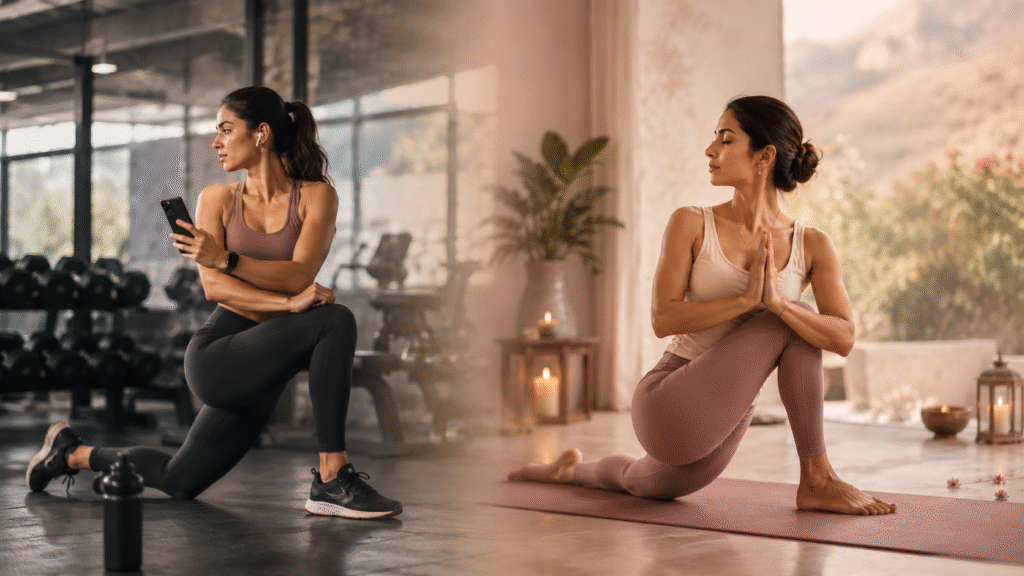
When we exercise, our goal is usually physical. We want strength, stamina, flexibility, weight loss, better health, or athletic performance. There is nothing wrong with that. Exercise is wonderful for the body.
But exercise can also happen on autopilot. You can spend an hour in the gym while your mind is worrying about tomorrow’s meeting, replaying yesterday’s argument, or deciding what you’ll have for dinner. Your body may be fully engaged while your mind is somewhere else entirely.
Yoga asanas ask for something different. They ask you to arrive. Your breath matters. Your awareness matters. Your drishti, your gaze, matters. The sensations within the body matter. The state of your mind matters.
Every posture becomes an opportunity to unite your body, your breath, and your awareness into a single experience.
That is why the same movement can either be exercise or yoga. It isn’t the posture that changes. It’s the consciousness behind it. That realization stayed with me for years.
Exercise and yoga asanas are not the same. Yoga is certainly much deeper than simply moving your body around.
But over the years, I noticed something interesting. The sentence “Yoga is beyond asanas” became so popular that nobody seemed to question it anymore. Everyone simply repeated it. And that got me thinking.
Is yoga really beyond asanas? Or have we misunderstood asanas themselves?
Human beings have always loved trends. One person says something insightful. A few people repeat it. Soon everyone repeats it. Eventually, the sentence becomes accepted wisdom without anyone stopping to think about what it actually means.
Ironically, even rejecting trends becomes a trend.Someone says, “Don’t follow trends. Be original.” Soon thousands of people are proudly following the trend of not following trends.
Life has a funny way of doing that.
We often become so busy repeating ideas that we forget to examine them ourselves. One example that always fascinates me is “Lord Buddha”.
After his enlightenment, Buddha discouraged blind belief and encouraged direct experience. His teachings invited people to investigate reality for themselves instead of depending upon authority.
Yet what happened over time? Millions began worshipping Buddha himself. The very person who encouraged seekers to look within became the object people looked toward. Whether one agrees with every historical detail or not, the pattern itself is fascinating.
Sometimes we become so attached to repeating an idea that we forget to practice the very wisdom behind it. And I sometimes feel the same thing has happened with the sentence:
“Yoga is beyond asanas.”
Years ago, saying this served an important purpose. People genuinely believed that stretching equaled yoga. It was necessary to explain that yoga was not merely physical exercise. That distinction was needed.
But somewhere along the way, I think we swung too far in the opposite direction. In trying to separate yoga from exercise, we accidentally separated yoga from asanas themselves.
And I don’t think that was ever the intention.
Here’s the question I keep coming back to. What exactly do we think an asana is?
If we believe an asana is simply placing one foot here, stretching one arm there, holding a pose for thirty seconds, then yes, yoga is obviously beyond that.
But that isn’t what yoga asanas were ever meant to be. An asana is not choreography. It is not gymnastics. It is not performance. It is not flexibility. It is not a beautiful photograph for social media.
An authentic yoga asana is already a complete yogic practice. When you truly practice an asana, your attention is fully present. Your breath becomes slower and more refined. Your mind naturally begins to settle. Your awareness expands inward. Distractions begin to dissolve.
Your body, breath, and mind stop pulling in different directions and begin moving together.
Isn’t that yoga?
If yoga means union, then isn’t that union already happening?
If yoga means mastery over the fluctuations of the mind, isn’t the mind already being trained during sincere asana practice?
If yoga leads us toward inner stillness, why assume that stillness cannot begin within an asana?
Patanjali gives us the famous Eight Limbs of Yoga.
Yamas, Niyamas, Asana, Pranayama, Pratyahara, Dharana, Dhyana, & Samadhi.
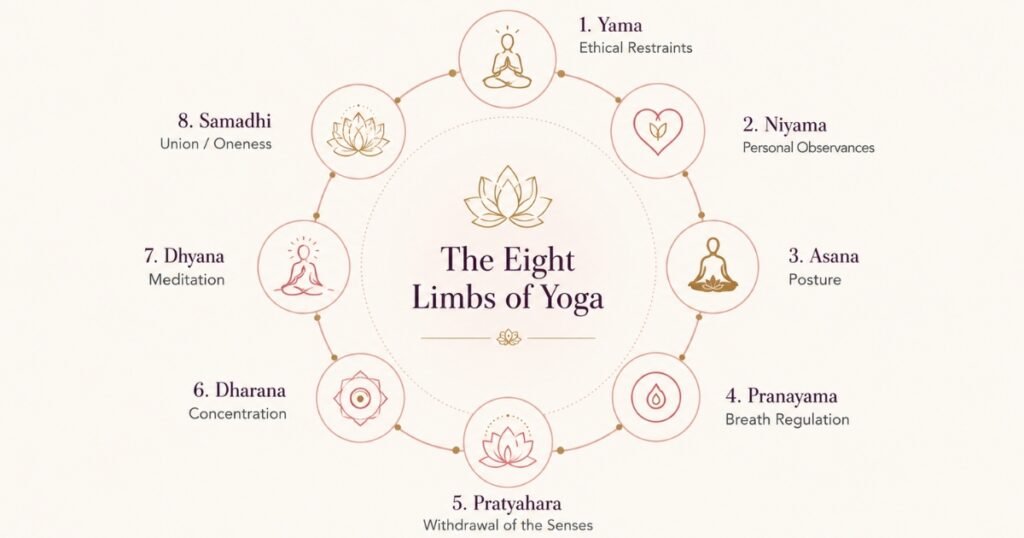
Many people look at these eight limbs as though they are steps on a ladder.
Finish one. Move to the next. Finish that. Move again.
Eventually you’ll arrive at Samadhi.
But yoga isn’t quite so mechanical. Each limb contains the essence of the whole. Deeply practicing one naturally nourishes the others.
If you sincerely practice ahimsa, non-violence, it transforms your thoughts, your relationships, your awareness, your mind.
If you sincerely practice pranayama, your concentration deepens.
If you sincerely practice meditation, mental clarity and enlightenment naturally evolve.
Everything supports everything else. The limbs are interconnected, not isolated compartments.
The same is true for asanas. A sincere asana practice is never just physical. As you hold a posture, you are practicing concentration. You are regulating your breath. You are observing your thoughts. You are cultivating patience. You are developing discipline. You are learning acceptance. You are witnessing the mind instead of being carried away by it. You are becoming present.
Without even realizing it, meditation has already begun. Pranayama is already happening. Dharana, concentration, is already unfolding. The journey inward has already started.
So while asanas are described as the third limb, they are never disconnected from the other seven. The beauty of yoga is that everything overlaps. Everything supports everything else. Everything points toward the same destination.
This is why I no longer feel comfortable saying,
“Yoga is beyond asanas.”
Instead, I would say something slightly different.
Yoga is beyond exercise.
But authentic yoga asanas are already yoga. There is an enormous difference between the two. The problem was never asanas. The problem was reducing asanas to physical exercise.
When practiced without awareness, an asana becomes exercise. When practiced with breath, attention, presence, and inner observation, that very same posture becomes yoga.
Nothing about the posture changed. Only the practitioner did. And perhaps that is the most beautiful lesson yoga has to offer.
Yoga has never been hiding somewhere beyond the mat. Sometimes it has been quietly waiting within every single posture all along.
So the next time someone confidently says,
“Yoga is way beyond asanas,” you don’t have to argue. You don’t have to correct them.
Simply smile.
Because maybe the real understanding isn’t that yoga is beyond asanas. Maybe it’s that we have forgotten what an asana truly is.
Now, before someone says it, let me acknowledge something.
Yes, yoga is vast.
There are many beautiful paths within yoga. Bhakti Yoga, the path of devotion. Jnana Yoga, the path of knowledge and self-inquiry. Karma Yoga, the path of selfless action. Raja Yoga, the path of meditation.
If someone says, ‘Yoga is beyond asanas because there are many other paths,’ I completely agree.
But that isn’t the point I’m questioning. I’m questioning the way we sometimes speak about asanas as though they are merely physical, while all the ‘real yoga’ exists somewhere beyond them.
Because once we understand what an authentic asana really is, that separation begins to disappear.
As someone who naturally resonates with Jnana Yoga, I understand the temptation to think that knowledge or self-inquiry is somehow ‘deeper’ than asanas. I used to think along those lines too. But over time, I realised something beautiful. Yoga never asks us to compare the paths. It only asks us to walk one sincerely. Whether you enter through devotion, inquiry, action, meditation, or the body, the destination remains the same.
Asanas are not competing with Bhakti Yoga or Jnana Yoga. They are simply another doorway into the same experience.
The destination isn’t different. The entrance is.