
I was in my third year of college when Vipassana meditation entered my life. It was a turbulent phase, emotionally and physically. I was barely 21, confused, sensitive, intense, and going through more internally than I showed externally. Around that time, one of my teachers had just returned from a 10-day Vipassana retreat. She spoke about it with a kind of calm conviction that I had never seen before.
She guided me through the process and told me something that stayed with me. She said, “Only people who have done something good in their past lives get to experience this meditation.” That line sat quietly in the back of my mind. Maybe it was spiritual. Maybe it was psychological. But it worked. I felt chosen. Or at least, curious enough to try.
I had never stayed away from my family for that long before. Not talking to them for 10 days felt unimaginable. But something inside me was already low, already searching. And strangely, these strict rules did not scare me. They felt like structure. They felt like discipline. They felt like maybe this is what I needed.
The Rules That Felt Extreme But Necessary
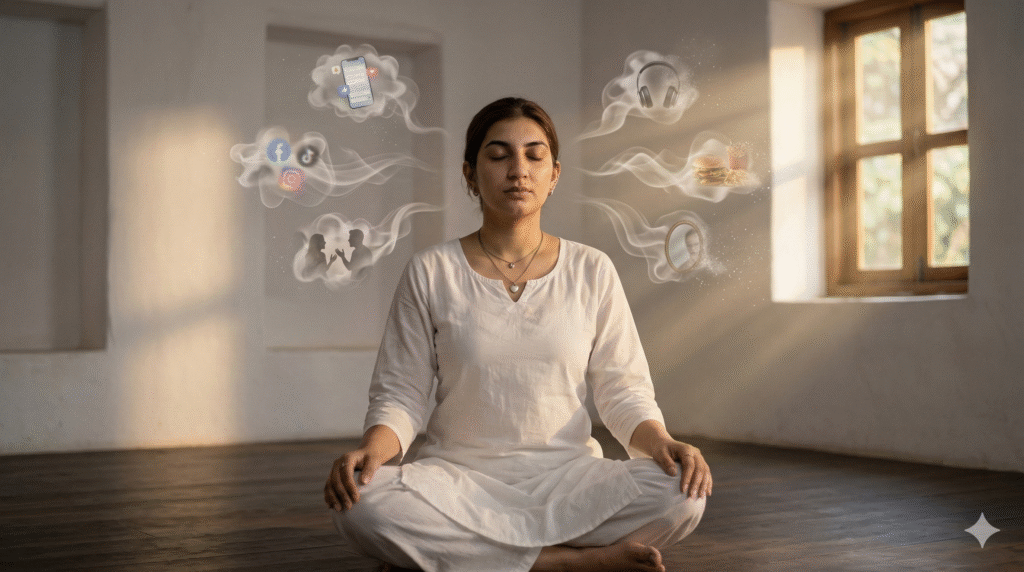
The rules were clear and non-negotiable. No books. No phone. No communication. Maintain noble silence. Stay within the meditation center for 10 days. Meditate for long hours every single day. Eat only twice a day with a light, healthy snack in the evening. I lost almost two kilos by the end of it. We could carry a few clothes and a watch. That was it.
There were also moral precepts to follow. No intoxication. No lying. No stealing. No violence. No sexual misconduct. The simplicity of these rules felt grounding. For 10 days, your only job is to observe.
At 21, that felt intense. But I am someone who has always loved facing my own mind. I like sitting alone with my thoughts. I like observing inner conflict. I like talking to myself. So the idea of sitting silently with my own mind did not scare me as much as it might scare others. And somewhere, that line about good karma kept echoing. I had to do it.
Arrival And The Shock Of Silence
I went with no expectations. I submitted my phone and valuables at the reception. That act alone felt symbolic. As if I were surrendering the outer world for a while. After orientation, where they explained the schedule and the discipline, silence officially began.
We had private rooms with attached washrooms. In my compound, there were four other girls, all from outside India. We could not speak, but over the days, they became dear to me in the most silent way possible.
Every morning at 3:30 am, a volunteer would ring a bell. By 4 am, we had to be seated for meditation until 6 am. On the first day, I learned the literal meaning of Vipassana, to see things as they are. Vi means as it is, and passana means to see. To see reality as it truly is.
It sounded beautiful in theory.
In practice, my inner talking that I thought would last for days was over in thirty minutes. After that, there was panic. Heat. Countless insects. A completely new schedule. Watching the watch constantly. Peacocks screaming at 2 am. Barely sleeping. The environment itself became a challenge. It took me three to four days to adjust to this rhythm.
The Discourses That Made Everything Make Sense
Every night, we would listen to a two-hour discourse by Mr. S. N. Goenka. Those two hours were my favourite part of the day. Every word felt practical. Logical. Deep, yet simple.
He explained how the mind reacts constantly to sensations. How every sensation in the body is linked to a reaction in the mind. In Vipassana, we observe sensations on the skin and throughout the body. Gradually, we start observing subtler sensations like pulse and heartbeat. The instruction is simple. Observe without reacting. Do not change posture immediately. Do not scratch at the first itch. Do not chase pleasant sensations. Do not resist unpleasant ones.
That is the goal. Realistically, it takes time. But slowly, it does get easier not to respond immediately.
The Turning Point
After the initial struggle, something shifted. The heat became tolerable. The insects became tolerable. The peacocks became tolerable. The same environment that felt unbearable started feeling neutral. Just like the sensations in the body.
I began to observe my heartbeat at different places. I noticed that I did not rush to itch the second I felt discomfort. My tolerance increased. My reactivity reduced. I was not suppressing. I was observing.
The routine that felt exhausting at first started feeling nourishing. There was a strange joy in simplicity. Wake up. Meditate. Eat. Walk. Meditate. Listen. Sleep. Repeat.
Occasionally, I would make eye contact with the girls staying near my room. In that silence, even eye contact felt like a conversation.
What Vipassana Taught Me About My Life
The most powerful realisation came quietly.
In Vipassana, we are taught that every sensation arises and passes away. Nothing is permanent. Pleasant sensations change. Unpleasant sensations change. Everything is in constant flux.
Somewhere in those 10 days, I realised that my emotional struggles were also sensations. They felt permanent. They felt overwhelmed. But they, too, were arising and passing.
The problems that looked huge in my mind began to look workable. And sometimes, when observed deeply enough, they did not even remain problems. They were just reactions layered over reactions.
Just like sitting through an itch without scratching, maybe life also requires sitting through discomfort without immediately reacting.
After Those Ten Days
I came back different. Not dramatically enlightened. Not floating above the ground. But steadier. More observant. Less impulsive.
I had more to say on the last day when silence was lifted. But strangely, I also had much more to observe.
Vipassana was intense in the beginning and simple in the end. Or maybe I changed in between.
I genuinely believe everyone should try it at least once in their life. Not because it is easy. Not because it is mystical. But because it shows you your own mind without filters.
And that is a rare experience.