
When we begin exploring Indian philosophy, one of the first big questions that arises is: Who am I really?
Am I the body, the mind, the personality, or something deeper?
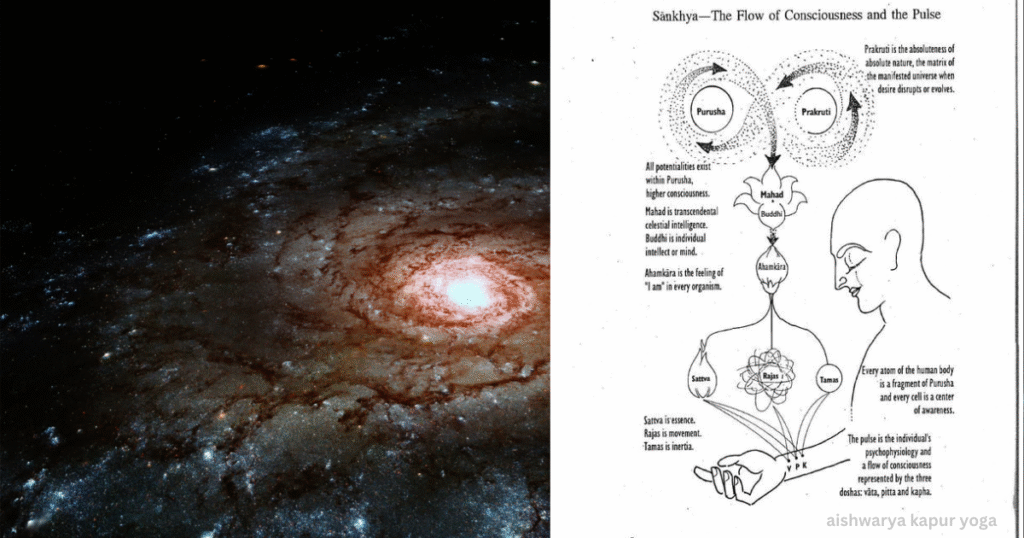
The ancient philosophy of Sāṅkhya, one of the oldest philosophical systems of India, answers this question with incredible clarity. It tells us that our true nature is Purusha, the silent witness, the pure consciousness that observes life but is never touched by it.
According to Sāṅkhya, everything in existence can be divided into two fundamental realities:
- Prakriti, nature, matter, body, mind, emotions, thoughts, the entire universe of change.
- Purusha, pure awareness, the observer, the unchanging witness.
All our struggles, joys, fears, and ambitions belong to Prakriti.
But the one who experiences them is Purusha.
Understanding this distinction is the heart of Sāṅkhya philosophy, and it leads us to a fascinating question that many people don’t expect:
Are all beings sharing one single soul? Or are there many individual souls?
Sāṅkhya gives a very unique and powerful answer.
The Nature of Individual Souls in Sāṅkhya
“From the diversity of births, deaths, and faculties, the plurality of Purushas is established.” (Sāṅkhya Kārikā 18)
In Sāṅkhya philosophy, Purusha means the conscious self or soul.
Sāṅkhya makes a very bold claim.
Souls are many, individual, and finite in number.
They are not being created constantly.
Let us understand how Sāṅkhya arrives at this.
Everyone experiences life differently
Look around.
One person is happy, another is suffering.
One is born rich, another poor.
One is healthy, another sick.
One attains liberation, another remains trapped.
If there were only one universal soul, then everyone would experience the same thing at the same time.
But that clearly does not happen.
So Sāṅkhya says, experiences are different because the experiencers are different.
This proves many Purushas exist.
Liberation happens individually
In yoga and Sāṅkhya, one person becomes enlightened while others remain in ignorance.
If there were only one soul, then when one person became free, everyone would become free simultaneously.
But liberation happens person by person.
Therefore, souls must be separate individuals.
Why Sāṅkhya says souls are limited
Sāṅkhya believes the universe runs in cycles.
Creation and dissolution repeat endlessly.
Nothing is created from absolute nothing.
So when new bodies are born, Sāṅkhya says new souls are not being manufactured.
Instead, existing Purushas take new bodies, just like people changing clothes.
This means the number of souls remains constant.
No new souls are added.
No souls are destroyed.
They simply move from body to body until liberation.
According to Sāṅkhya, souls are many, individual, eternal, and constant in number, they are never created, only embodied again and again until liberation.
A Yogic Reflection
One of the most beautiful aspects of Indian philosophy is that different paths often describe the same truth from different angles.
Some traditions speak of one universal Self.
Sāṅkhya speaks of many individual Purushas.
At first, this may feel contradictory. But the deeper we explore yoga, the more we realize that different paths are meant for different minds, different personalities, and different temperaments.
Every sincere path, whether it is Sāṅkhya, Vedanta, Bhakti, Tantra or Yoga, ultimately points toward freedom from suffering and recognition of our true nature.
Instead of choosing one philosophy to reject another, we can see them as different doorways leading toward the same inner realization.
Conclusion – The Journey of the Individual Soul
Sāṅkhya presents a deeply comforting and empowering view of existence.
It tells us that each of us is an individual conscious being on our own unique journey through life. Our experiences are not random, and some universal mind does not share them. They belong to our own Purusha, witnessing its long journey through countless lifetimes.
Souls are not being created every day. They are eternal travelers, taking different bodies, different roles, and different experiences until they finally recognize their true nature and become free.
Liberation, in Sāṅkhya, is beautifully simple.
It is the moment when Purusha realizes,
“I was never the body, never the mind, never the story.”
And with that realization, the journey ends.
This perspective reminds us that life is not a race against others. Every being is walking their own path, at their own pace, toward the same ultimate freedom.
And perhaps the most comforting thought of all, we are not lost in the universe; we are simply on a very long journey home.